How to Keep an Inheritance From Tearing You and Your Siblings Apart
Money, grief and old sibling rivalries can be a difficult combination. These four steps can help families talk about inheritance now and avoid conflict later.


The "Great Wealth Transfer" is shifting trillions of dollars between generations, but for many families, it is sparking a silent crisis. Despite the high stakes, inheritance remains a taboo subject — often more difficult to discuss than even dating.
This silence carries a heavy price: It opens the door to misunderstandings that can fracture sibling relationships during times of grief. To protect your legacy and maintain family harmony, it is time to move beyond silence.
Proactive, collaborative planning is the key to preventing conflict. If you're unsure where to begin, here are actionable tips from experts to help keep your family on the same page.
From just $107.88 $24.99 for Kiplinger Personal Finance
Become a smarter, better informed investor. Subscribe from just $107.88 $24.99, plus get up to 4 Special Issues

Sign up for Kiplinger’s Free Newsletters
Profit and prosper with the best of expert advice on investing, taxes, retirement, personal finance and more - straight to your e-mail.
Profit and prosper with the best of expert advice - straight to your e-mail.
1. Break the ice creatively

Talking about estate planning is weird, especially if you have other siblings. The last thing you want to contemplate is the loss of a loved one; adding financial logistics to the mix can make an already uncomfortable conversation feel even more daunting.
However, there are easy ways in. Lindsay Bryan-Podvin, licensed master social worker (LMSW), financial therapist and founder of Mind Money Balance, told Kiplinger, "Be creative when opening the door to that kind of conversation. One jumping-off point could be a friend dealing with a parent passing away and all the hoops they had to jump through to settle the estate."
"This can open the door to asking if everything is in place." Podvin also recommends this become a conversation you have with other siblings and parents multiple times. "Keep in mind that each person might remember things differently when you chat, so having multiple conversations ensures everyone is on the same page and concrete details are ironed out."
This checklist can help you get the talks started:
- Schedule a time to talk with all siblings and parents in a distraction-free environment
- Ask open-ended questions, like, "What is your vision for your legacy?"
- Discuss crucial details, such as payable-on-death beneficiaries, funeral arrangements and estate plans.
- Acknowledge the emotional weight — both yours and your parents'.
- Establish a regular check-in cadence to keep the conversation open.
Before beginning, knowing how generations view money can help you understand others' perspectives.
2. Understanding the generational disconnect
Maggie Baker, Ph.D., financial psychologist and author of Crazy About Money, told Kiplinger that she believes older generations used to think it was a taboo topic to discuss.
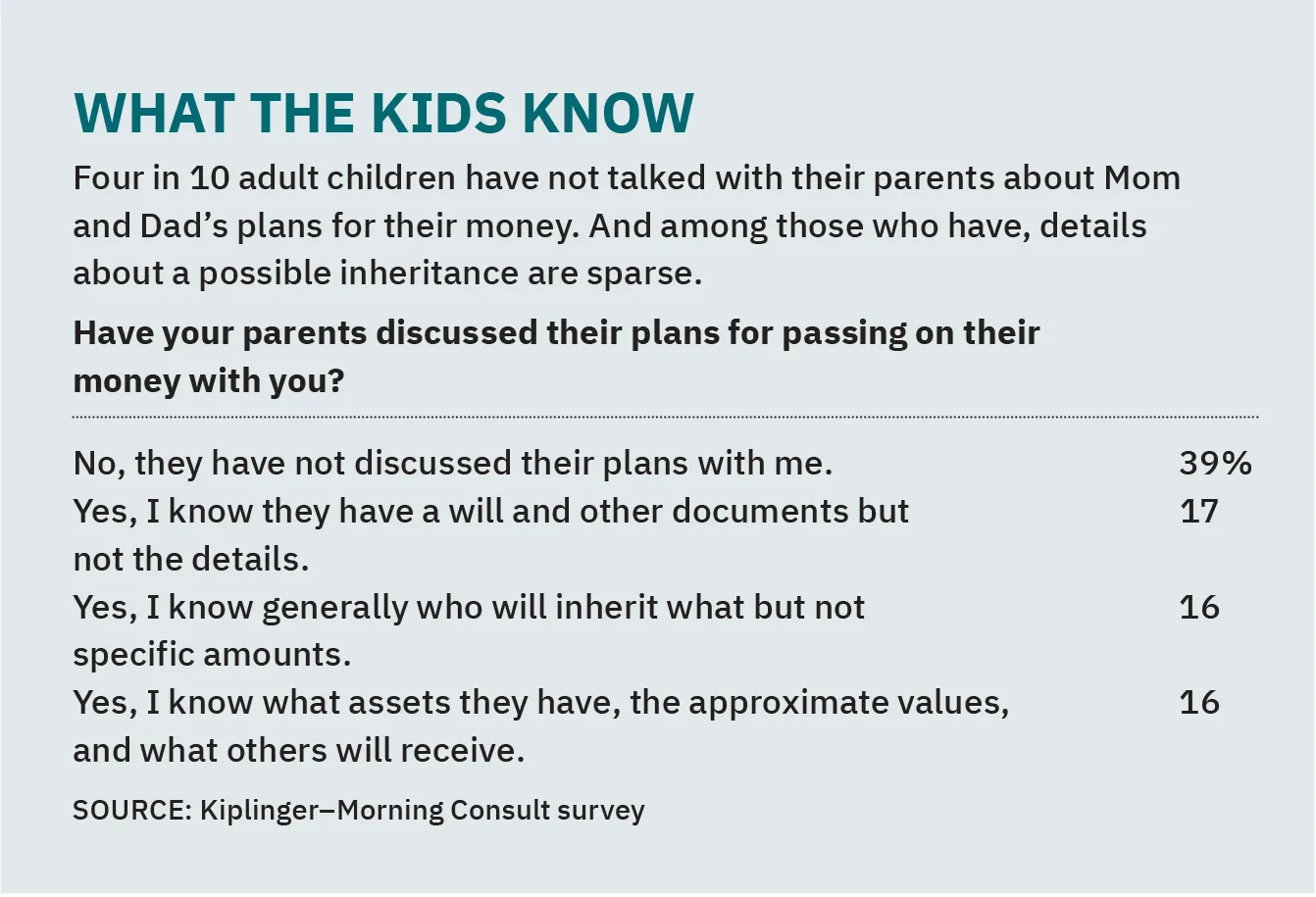
That generational divide becomes clearer in a Morning Consult survey commissioned by Kiplinger as part of our Trillion Dollar Talk campaign, which found that adult children would rather talk to their parents about almost anything besides inheritance, including politics, their parents' physical and mental health, and when they'd be getting married or having kids. The survey also found that parents plan to split the inheritance evenly, while kids prefer to split it differently.
Failing to discuss estate plans in concrete terms can create confusion later, especially when children are left to sort through documents and piece together their parents' wishes. What parents intend, and what they write down, can be difficult to parse.
An omission can be the focal point that drives division between siblings, where natural rivalries can already occur. That's why a change of approach can make all the difference when discussing inheritance. Instead of thinking of it merely in dollars and property, shift the focus to living legacy. What do you want your inheritance to communicate to your loved ones?
On this front, Baker recommends creating an ethical will. This ensures parents share their values about money with children so they can have trust and assurance.
Doing this can shift the focus away from talking about money only, which can be a taboo topic for older generations, and toward actionable strategies to ensure a living legacy they would be proud to bestow. Planning is vital now because when that day comes, grief can cloud clarity.
3. Prepare for the 'fog of grief'

Losing a loved one can be a surreal and extremely stressful experience. It impacts your physical, emotional, relational, spiritual and cognitive lives. It can make even simple things such as doing the laundry or cooking dinner seem like insurmountable tasks.
Another aspect that can add stress and sibling division, if not already planned, is end-of-life expenses. Podvin recommends, "Have a savings account earmarked for funeral expenses. Since it can take estates 12 to 18 months to settle, this prevents you or other siblings from going into debt to pay for the expense."
Here is my recommendation when searching for savings accounts:

Talk to your parents about designating one or more siblings as a payable-on-death (POD) beneficiary. Upon the loved one's death, the bank will release the funds to that beneficiary, who can use them to pay for funeral and other expenses as they arise without having to go through probate.
It's also important to take some time to heal. Grief can manifest itself in many forms, but so can comfort. One effective strategy is "body doubling" — asking a friend to accompany you on a walk or lunch. This simple presence can help you absorb their energy, reducing some of the stress and pain.
As you come together as siblings to make decisions, don't overlook this one component.
4. Address inequality and resentment directly

When you discover how your parents or older loved ones divided assets and cash, it could make one or more siblings feel overlooked. This is why it's important to share how you feel without attacking anyone else.
To demonstrate, if an aging parent falls ill, one sibling likely serves as a caretaker. One way to support someone who's already been stressed in that situation is for the other sibling(s) to acknowledge the caregiver's work.
Podvin recommends, "Make sure to give them a token of your appreciation. One way to do this could be paying for a trip so they can go away and relax after all the work they did or give them some money to help offset the work they missed while helping the loved one."
Regarding the difficulty of processing these feelings of missing out or anger, Baker suggests, "You should call on a financial therapist. Especially if you're hearing echoes from the grave. You can't resolve it because the person isn't there. With a therapist, they have an idea of how to stop the rumination."
Ultimately, direct communication between siblings and parents can help to eliminate many of the conflicts caused by inheritances. By finding creative ways in, ironing out concrete details in advance and sharing/acknowledging when one sibling has done more work than the other, it can reduce tensions from arising at a time when you should be coming together.
As parents, opening the door to this conversation also ensures you're leaving an inheritance that reflects your values and legacy.
If you expect to receive an inheritance, speaking with a financial adviser can help you make plans to maximize your wealth and achieve your financial goals while keeping in mind your relative's values, so you're not overwhelmed when you receive it.
Use the tool below to connect with a vetted financial professional who can help:
More Trillion Dollar Talk
- Manage an Inheritance Like a Pro in Just 7 Steps
- Keep, Sell, or Rent? What Happens Tax-Wise When You Inherit a House
- What Happens When You Inherit a House — With Your Siblings
- Why Leaving an Equal Inheritance to Your Children Could Backfire